Track ID
Find the track ID in any DJ set
A track ID is a song in a DJ set or mix that nobody has named yet. Paste the link to the set and the released tracks come back with their timestamps.
You'll see the length and the price in hours before you pay.
Not sure what it returns? See a resolved set first.
What is a track ID?
Last updated
A track ID is a song played in a DJ set or mix that nobody has identified yet. In a written tracklist the word ID stands in for the missing part of the credit: ID - ID means both the artist and the title are unknown, and Artist - ID means only the title is missing. In the comments under a set, “track ID?” asks someone to name the song playing at that moment. IDs exist because DJs play music the crowd cannot name by ear: unreleased promos, dubplates cut for one DJ, private edits, obscure records, and released tracks buried in a blend. Some DJs keep their IDs quiet on purpose, to protect a coming release or an edit of their own. Audio fingerprinting can only name a track once it has been released, so those IDs stay open until the record comes out. Setlist.ID fingerprints a whole recording from its link and returns the released tracks with their timestamps.
What that looks like written out is on this site already: every mix identified here is published with a timestamp on each track and the unmatched passages left marked as IDs. Read the sets we have identified, or start from the genre you are digging in.
How to read the IDs in a tracklist
The notation is informal but consistent across 1001Tracklists, SoundCloud comments and forum threads. What is known goes where it belongs; ID fills the gap.
| Written as | Means |
|---|---|
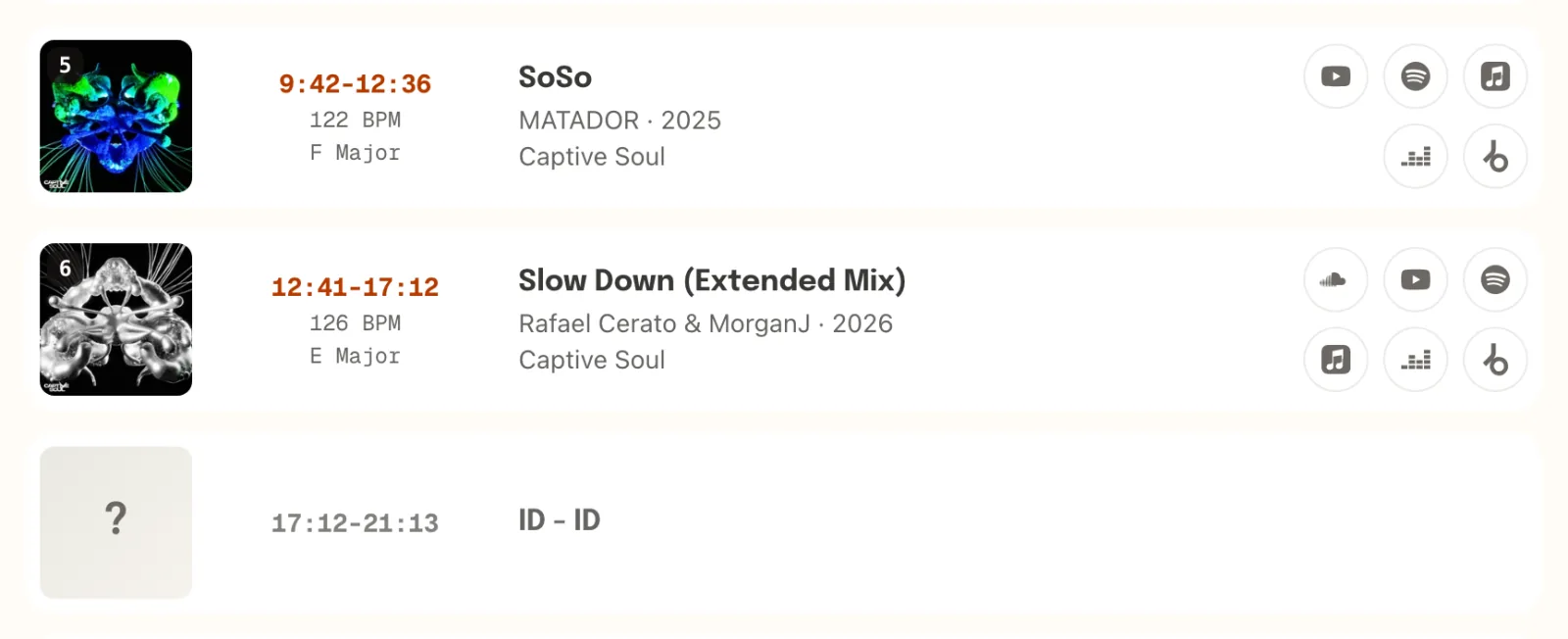
| ID - ID | Artist unknown, title unknown. The fully open case. |
| Artist - ID | The DJ or producer is known (often because it is their own unreleased music); the track is not. |
| ID - Title | The title is known, usually from a vocal hook or a caption, but nobody has placed the artist. |
| ID (Artist Remix) / (Artist Edit) | The original is unknown; the remixer or editor is known because they played it. |
| Artist - Title w/ ID | A known track layered with an unknown one. The w/ marks a mash-up or a tool played on top. |
| ??? | Older tracklists and forums use question marks instead of ID. Same thing. |
| “Track ID?” / “whats the ID” | A comment asking the room to name the track playing at that timestamp. On SoundCloud the timed comment marks the exact spot. |
How to find a track ID
Five ways, in the order worth trying them. The first three cost nothing but time and depend on other people; the last two read the audio itself.
- 1
Read what is already there
Check the description, chapter markers, pinned comments and, on SoundCloud, the timed comments under the waveform. Many IDs are answered in the thread within days of an upload; the answer is often two replies below the question.
Works for: Popular uploads with an active comment section.
- 2
Search the set itself
Databases like 1001Tracklists and MixesDB hold community-built tracklists for well-known sets, and the DJ's own posts sometimes list what they played. If the set is famous, someone may already have documented the track you are hunting.
Works for: Festival sets, radio shows, big-name DJs.
- 3
Ask, with a timestamp
Comment on the upload or post in a track ID thread (r/DJs, r/Techno and genre forums run them). Give the link, the exact timestamp and what plays around it. A vague request gets ignored; a precise one gets answered by someone who owns the record.
Works for: Anything a human insider recognises, including unreleased music.
- 4
Shazam at the right moment
Hold the app up during a clean section of a released track and it may name it. It fails through blends, pitch shifts and layered tracks, it answers one song per attempt, and it gives no timestamp against the recording, so it becomes a two-hour job for a full set.
Works for: A single released track playing cleanly.
- 5
Fingerprint the whole recording
Paste the link to the set and the complete audio is cut into overlapping segments and matched by our own recognition algorithm, which draws on partners including ACRCloud and Shazam. Everything with a release comes back with its timestamp, and the sections that stay unmatched are marked, which is your shortlist of true IDs.
Works for: Any recording at a link.
Get every track ID from a link
This is method five in practice. The excerpt below is real output from a set identified on Setlist.ID.
Fred again.. | Boiler Room: London · identified by Setlist.ID
 0:01HomicideConnor James
 2:34Kammy (like i do)Fred again..
 7:20Danielle (smile on my face)Fred again..
 10:01Tanya (maybe life)Fred again..
- 13:12Carlos (interlude)Fred again..
- 1
Copy the link to the set
YouTube, SoundCloud, Mixcloud or any of 100+ supported platforms. The recording is pulled from the source, so nothing is recorded on your device.
- 2
Paste it into Setlist.ID
Sign in or create an account, review the length and the price in hours, and confirm. Nothing is spent until you do.
- 3
The full recording is fingerprinted
Overlapping segments, each matched against the released catalogue. Overlap is what survives the transitions: every blend has a window where each record shows enough of itself.
- 4
Read the resolved tracklist
Every identified track in play order with its timestamp, artist and title, BPM and key, and links to YouTube, Spotify, Deezer and Beatport. Export it as text, clipboard, YouTube chapters or a playlist.
Why some IDs stay IDs
Fingerprinting can only match what has been released. An unreleased promo, a producer's private edit, or a dubplate cut for one DJ has no entry in any database, so no software can name it until it comes out. Some DJs keep those IDs quiet on purpose: to protect a launch, to guard an edit that sets their sets apart, or because they never list what they play.
What a full-recording pass gives you for those is precision. Instead of “somewhere in the second hour” you get the exact window where the unmatched track plays and the released tracks either side of it. That turns a vague hunt into a good ID request: the link, the timestamp, and what it was mixed out of and into. Post that in the comments or a track ID thread and the person who owns the record can answer in one line.
Track ID questions
What does track ID mean?
A track ID is a song in a DJ set or mix that has not been identified. In a written tracklist the word ID stands in for the missing name. In a comment, “track ID?” is a request for someone to name the song playing at that moment.
What does ID - ID mean in a tracklist?
Both halves of the credit are unknown: the first ID is the artist, the second is the title. Artist - ID means the artist is known but not the track, and ID - Title means the title is known but not who made it.
What does “whats the ID” mean in the comments?
The commenter is asking for the name of the track playing at that point in the recording. On SoundCloud the comment is pinned to a timestamp on the waveform; on YouTube people usually write the time in the comment itself. Replying with artist and title resolves the ID.
How do DJs find track IDs?
The same five ways in the same order: read the comments and description, search 1001Tracklists and MixesDB, ask with a timestamp, try Shazam on a clean section, and fingerprint the whole recording. Working DJs also trade IDs directly, which is why some answers never reach a public thread.
Can Shazam find a track ID in a DJ mix?
Sometimes, for a single released track playing cleanly. Shazam samples a few seconds and names one song, so blended, pitched and layered club audio defeats it, and it cannot process a whole recording or give timestamps. Setlist.ID analyses the full set from a link, which is what a complete tracklist requires.
Is there a track ID finder for whole sets?
Yes. Setlist.ID is a track ID finder that works from a link: paste the URL of a set on YouTube, SoundCloud, Mixcloud or any of 100+ supported platforms and every released track comes back with a timestamp. Unmatched sections are shown as gaps.
Can every track ID be identified?
No, and no tool can. Fingerprinting matches released catalogue, so unreleased tracks, private edits and dubplates cannot be named by software until they come out. For those, a timestamped gap plus a precise ID request in the right thread is the realistic route.
How long does it take?
A one-hour mix typically processes in under five minutes. You can leave the page and come back; the finished tracklist stays in your history.
What does Setlist.ID cost?
Setlist.ID is priced by the hour of audio: 1 hour of identification time covers 1 hour of mix, with a 15-minute minimum. Bundles start at 5 hours for $6, hours never expire, and any stretch that cannot be identified is refunded automatically.