What Is a Track ID? IDs in DJ Sets and Tracklists Explained
You’re listening to a DJ set when one track grabs your attention. You open the tracklist, jump to the right timestamp, and find two wonderfully unhelpful letters: ID. Sometimes it appears as Artist – ID. Sometimes the whole entry reads ID – ID. And under the video, several listeners may be asking the same question: “Track ID?”
So what are those two letters actually telling you? The track may be unreleased, but that is only one possibility. It could be an old release that the person writing the list did not recognize. The artist or title may also be kept private. This guide explains the different meanings, the common tracklist formats, and what you can try when the record you want still has no confirmed name.
Track ID Has Two Common Meanings
“Track ID” has two common meanings. The words around it tell you which one applies:
A request for the song’s name: If you comment, “Track ID at 36:12?” you are asking someone to name the artist, title, remix, or edit playing at that moment.
A placeholder in a tracklist: If the list shows ID – ID, the person or system that published it could not confirm the artist and title. Those details may also be intentionally withheld.
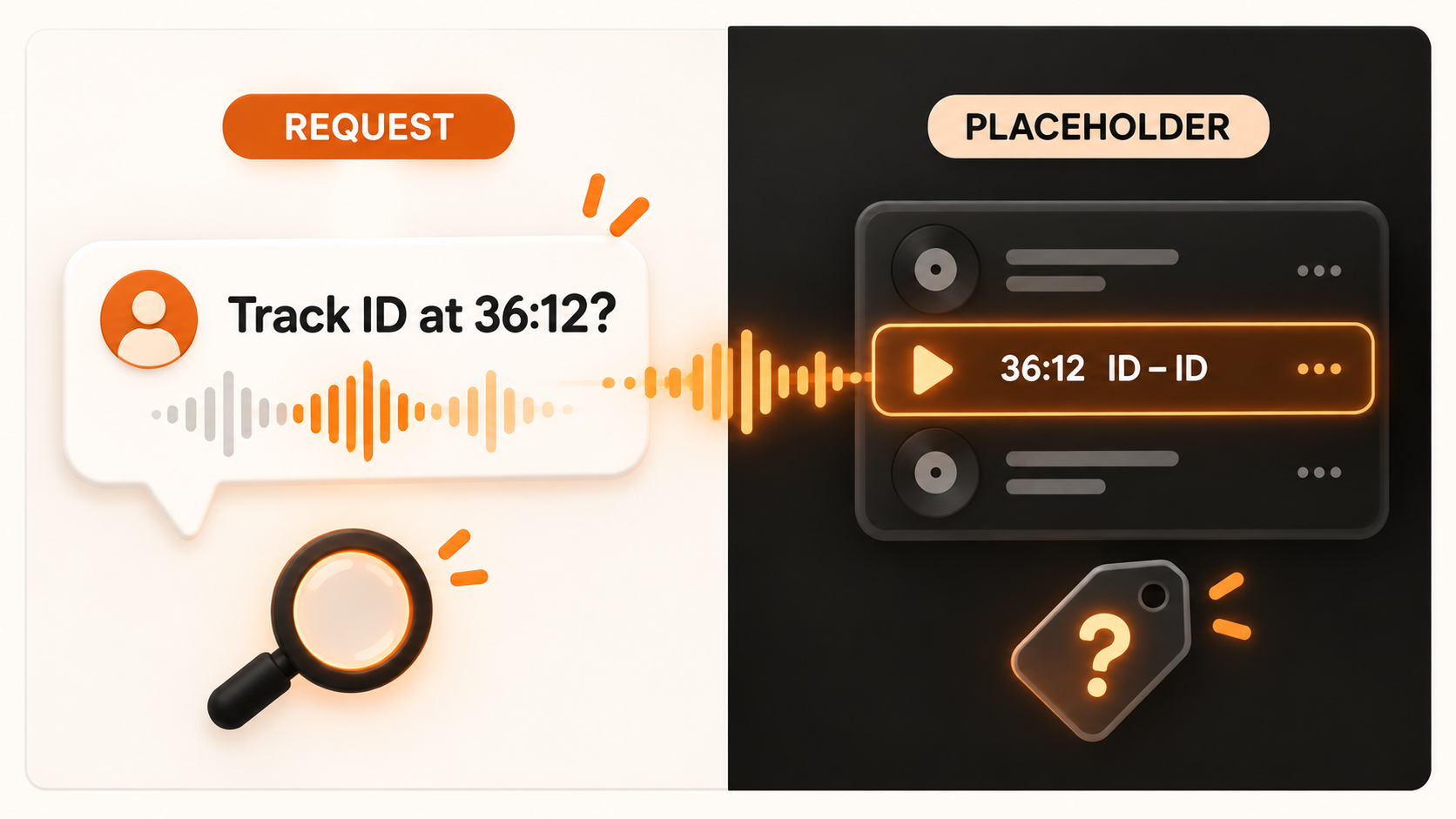
That difference matters. The DJ may know every record in the set. But a fan, a festival channel, a database editor, or a recognition tool may have created the tracklist. An ID does not mean the DJ forgot what was on the USB.
You may also see "Track ID" used as the name of a playlist or a product feature. In this blog, it refers to identifying music inside a DJ set.
Here Is How DJ Tracklist Notation Works
Most tracklists follow one simple order: artist first, track title second. When one detail is missing, ID takes its place. That is why ID – ID appears twice. Neither name has been confirmed yet.
Tracklist entry | What it means |
ID – ID | Neither the artist nor the title has been confirmed. |
Artist – ID | The artist is known, but the title is unknown or undisclosed. |
ID – Track Title | The title is known, but the artist is not. |
Artist – Track (ID Remix) | The original track is known, but the remixer has not been confirmed. |
? – ? | Another way to mark missing information. |
Artist – Untitled (A1) [Label, catalogue number] | The record may be identifiable even without a track title. |
Some databases use question marks. Others write Unknown or ???. The wording changes, but the empty position tells you what information is missing.
What Does ID Remix Actually Mean?
Pay attention to the brackets too. Artist – Track (ID Remix) is not a completely unknown record. The original has already been identified. Only the remixer is missing. Reading the full entry can save you from searching for the wrong thing.
An ID Is Not Always Unreleased
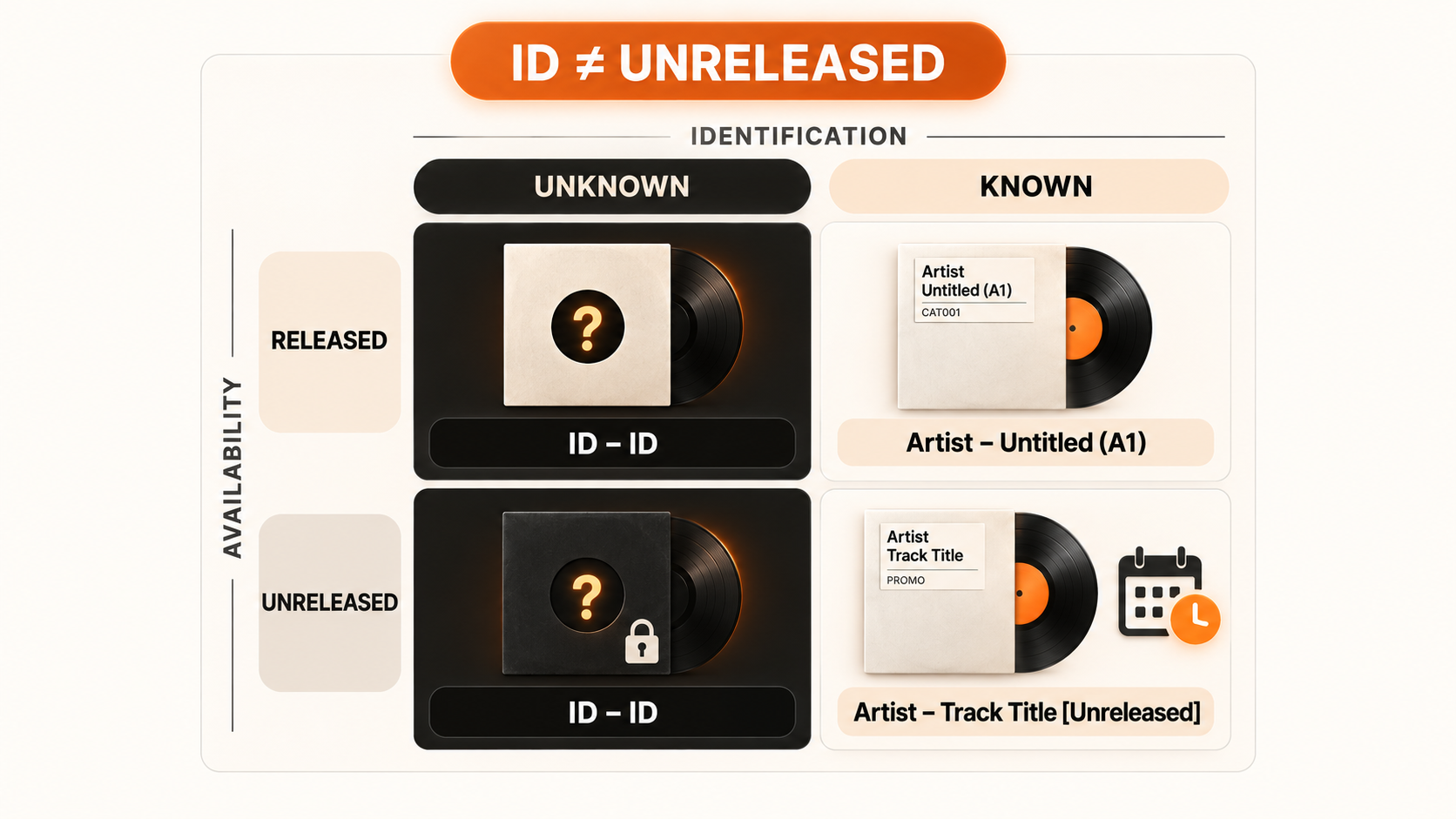
Seeing ID beside a track does not tell you if it has been released. It only says the person or system that published the list could not confirm or reveal part of its identity.
A 2025 study examined 4,902 DJ mixes containing 56,873 track links. Only 342 mixes, or 7%, had every track identified. So, even well-documented mixes commonly contain gaps.
What Does Unreleased Actually Tell You?
Now take Artist – Track Title [Unreleased]. Both names are known. You may not be able to buy or stream the track yet, but nobody is guessing its identity. The same applies to a forthcoming release. It has been announced, but its public release date has not arrived.
Can an Untitled Track Still Be Identified?
Untitled creates another common mix-up. A vinyl record can genuinely have no track title and still be traced through its artist, label, catalogue number, and side. A white-label or promo can also contain enough information to identify it.
The easiest way to separate the terms is to ask two questions:
Do we know what the track is? That determines its identification status.
Can the public access the official release? That determines its availability.
A released record can still be an ID in a fan-written tracklist. And an unreleased record can be fully identified. The two labels may overlap, but neither one proves the other.
Why Do Tracks Appear as IDs?
Tracks usually become IDs for one of two reasons: either nobody building the tracklist knows the answer, or someone who does not share it yet. That difference changes where you should look next.
The compiler missed it: A fan or uploader may not recognize a record that has already been released.
The track is not ready: Its producer may still be changing the title, mix, or arrangement.
The version is private: a DJ edit, bootleg, mashup, dubplate, or VIP may never be publicly released.
The audio hides it: Crowd noise, pitch changes, effects, or two overlapping tracks can prevent a clean match.
The information is restricted: A label embargo or private agreement may keep the artist or title off the published list.
Why Do DJs Keep Some IDs Private?
Some IDs Protect Music Before Release
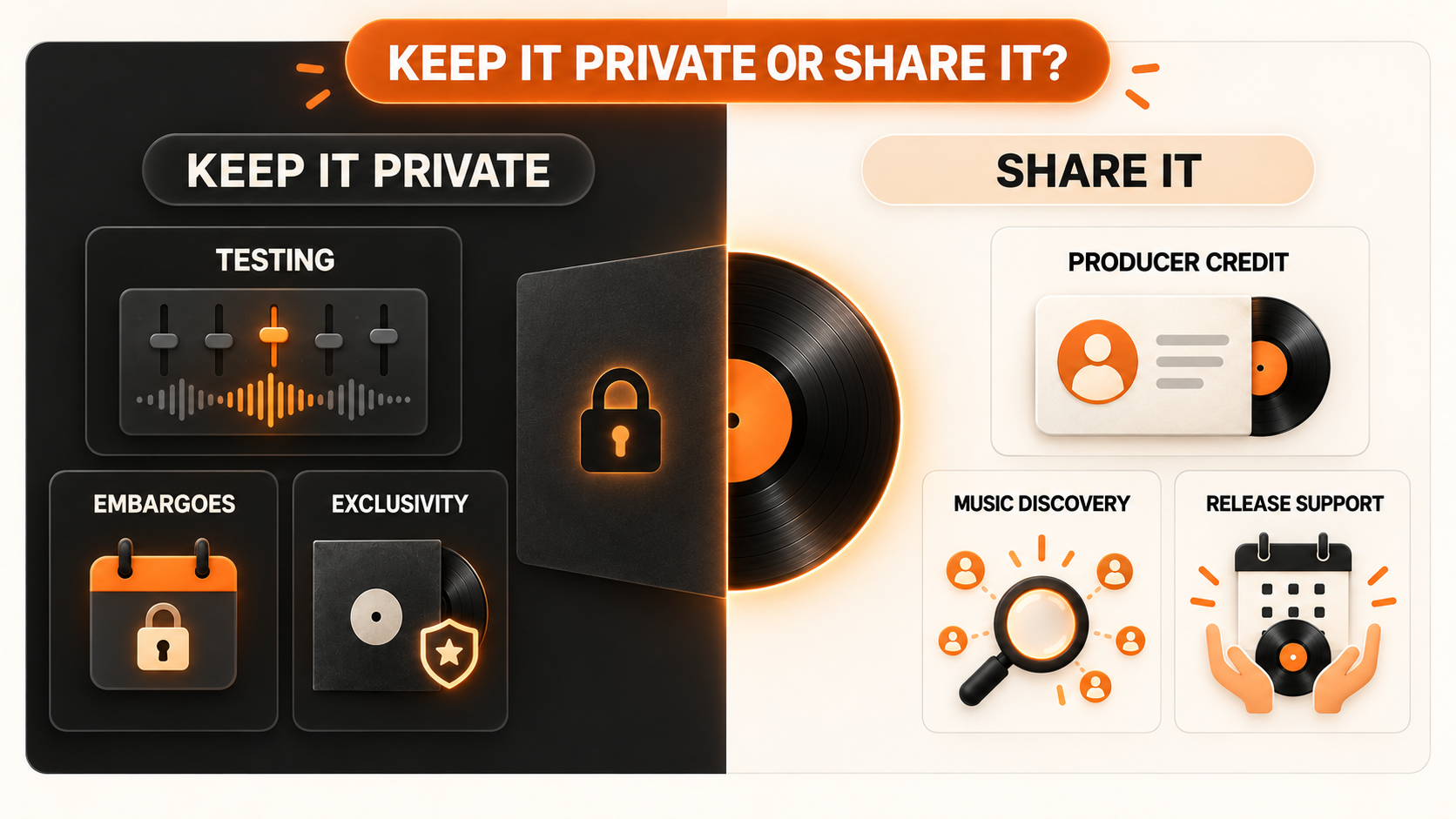
Some IDs stay private because the music is still being tested. A producer may send an early version to a few DJs, then change the drums, arrangement, or title after hearing it on a club system. A label may also set an announcement date, so naming the track early could spoil its release plan.
Then there are exclusives. Private edits, custom versions, and dubplates give a set something other DJs cannot easily copy. In those cases, keeping the name quiet is part of the track’s appeal.
But Secrecy Can Hide the Producer
But secrecy has a cost. A hidden ID cannot send listeners to the producer, label, or authorized release. That matters even more when a smaller artist makes the record and the DJ receives all the attention.
So, do not assume an unanswered ID request is arrogant. The DJ may be following an embargo, or the track may not have a final name. But once the release goes public, adding the artist and title gives the creator credit for the music the track has already earned on the dance floor.
Recognition Software Cannot Identify Every ID
Recognition software does not hear a bassline and work out who made it. It compares the audio against reference fingerprints stored in its database. If the right reference is missing or the recording is too messy, the software has nothing reliable to return.
What is playing | What may happen |
Clean released recording | A strong match is possible when its reference exists. |
Private or unreleased version | No match appears if the reference is absent. |
Two overlapping tracks | One track may match, or both may fail. |
Heavy pitch or tempo change | The altered fingerprint becomes harder to match. |
Crowd noise or a short clip | There may not be enough clear audio. |
Custom remix or DJ edit | The original may match, while the exact version stays unknown. |
That is why no result is proof that a track is unreleased. It may be an older release missing from that database, a private edit, or a busy transition. Read the result as “not matched yet,” not “this music has no name.”
How Setlist.ID Finds Tracks Inside Mixes
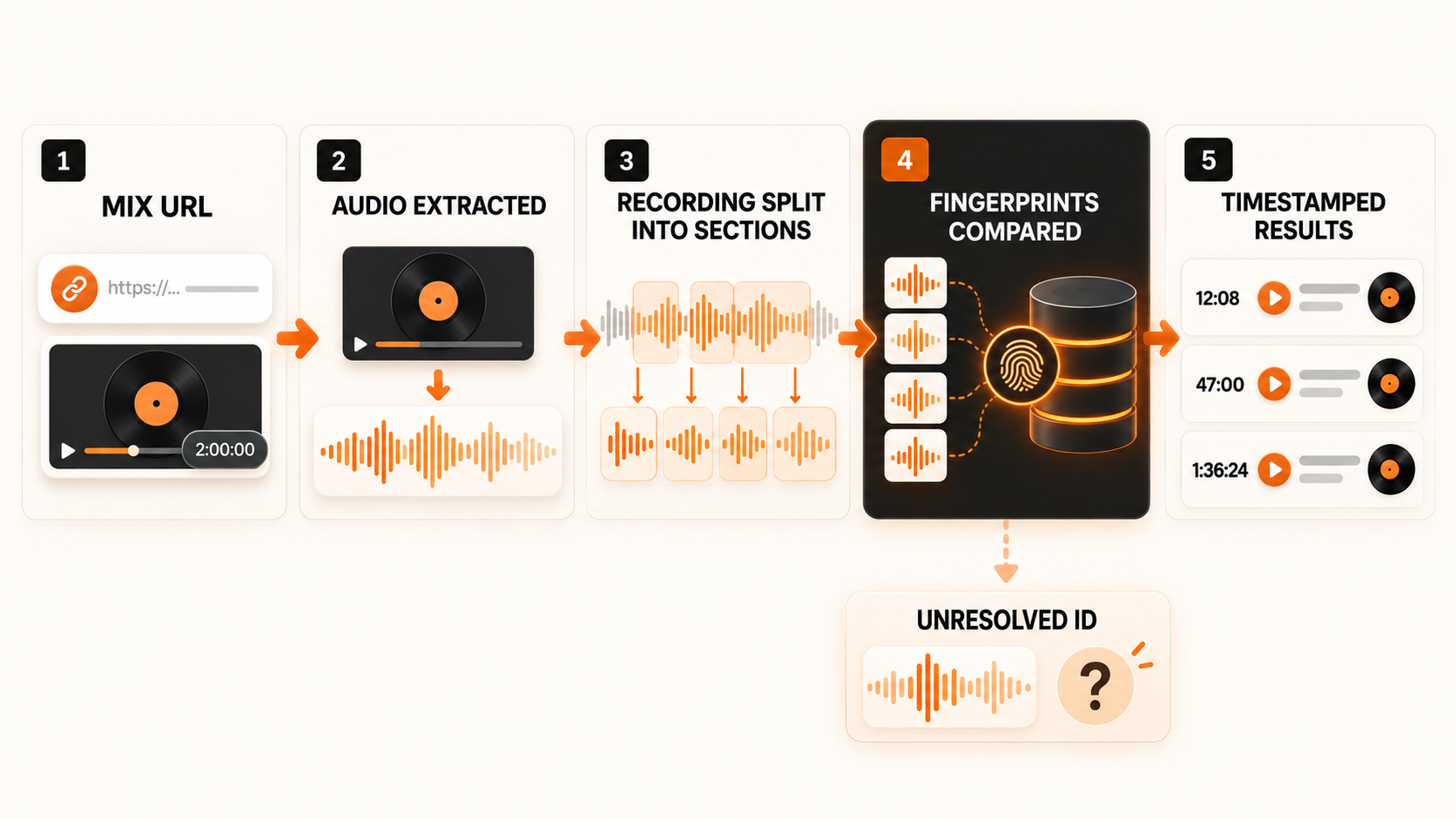
Setlist.id is a DJ tracklist set finder built for the track sitting 47 minutes into a mix that runs for two hours. Paste the full link to YouTube, SoundCloud, Mixcloud, Instagram, or another supported platform. You do not need to find and cut out a clean clip first.
What Happens After You Paste a Mix?
Setlist.id extracts the audio and divides the long mix into shorter sections. It then compares their fingerprints against its recognition database. Confirmed matches are returned in playing order, with timestamps and listening links.
Open each result and return to the exact moment in the mix. That check matters when a DJ plays an edit or remix that closely resembles the original. One section may also stay unresolved when two records overlap or no suitable reference exists.
Setlist.id reports the matches it can support. It does not add an invented artist or title just to complete the tracklist.
What Can You Try After No Match?
A failed match does not end the search. Start with the original upload because the DJ or uploader may have left clues in its description, tags, or timestamped comments.
Try this order:
Replay a cleaner passage where only one track is playing.
Search the DJ’s name, set date, and timestamp in published tracklists.
Check recent releases from any artist or label you suspect.
Ask the community using the mix link and exact timestamp.
A vague “track ID?” gives people very little to work with. “What plays at 42:18 in this set?” sends them straight to the right moment. Still no answer? Save the timestamp and return later. The producer, label, or tracklist editor may reveal it after release.
Now You Know What ID Means
Now, when you see ID beside a timestamp, you know exactly what it tells you. Some information is still unknown or undisclosed. It does not automatically mean the track is unreleased.
Check the notation, return to the timestamp, and look for the cleanest part of the recording. If the track is buried inside a full DJ mix, paste the link into Setlist.id. Its timestamped results can help you find the correct artist, title, and version.